
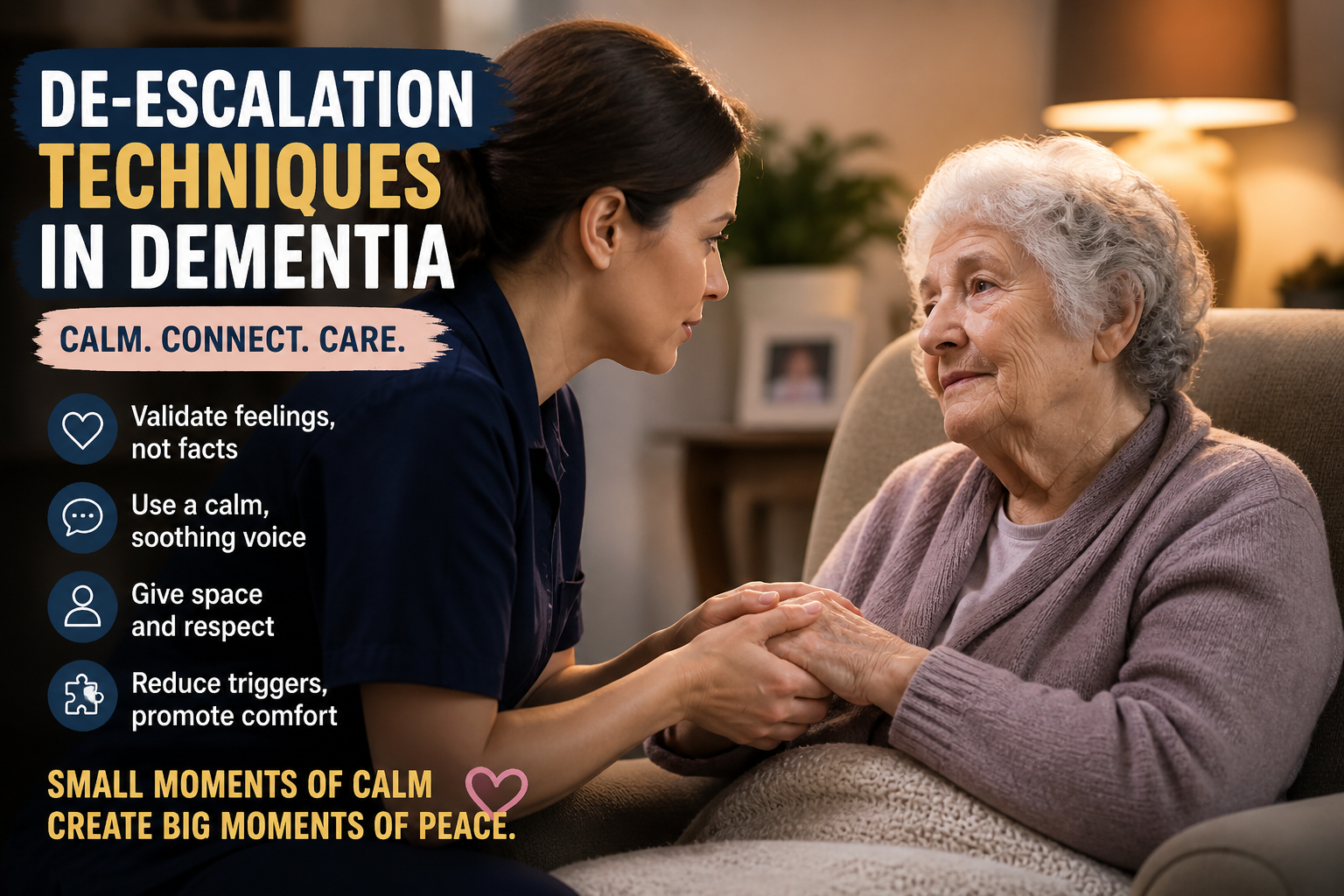
De-escalation techniques in dementia: A compassionate guide to calming agitation and aggression
De-escalation techniques in dementia are essential tools that help caregivers respond calmly, safely, and effectively during these challenging moments. Rather than reacting with frustration or fear, these techniques allow you to calm dementia patients, reduce distress, and preserve dignity.
At its core, de-escalation in dementia care means reducing emotional intensity and preventing escalation—without force, argument, or control.
It’s not about correcting behavior.
It’s about understanding it.
Quick Answer: What Are De-escalation Techniques in Dementia?
De-escalation techniques in dementia are communication and behavioral strategies used to calm agitation, prevent aggression, and create a sense of safety.
Key techniques include:
- Validating emotions instead of correcting facts
- Speaking in a calm, slow tone
- Reducing environmental triggers (noise, clutter)
- Giving space and avoiding confrontation
- Redirecting attention to calming activities
- Using simple language and patience
These techniques work because dementia affects reasoning—but emotions remain powerful and real.
What Triggers Agitation in Dementia?
Understanding triggers is the foundation of dementia behavior management.
Most aggressive or agitated behaviors are not intentional—they are responses to discomfort, fear, or confusion.
Common triggers include:
🧠 Physical discomfort
- Pain (arthritis, headaches)
- Hunger or dehydration
- Fatigue
- Infections (like UTIs)
🌍 Environmental stress
- Loud noises (TV, crowds)
- Bright lights or shadows
- Too many people talking at once
⏳ Emotional triggers
- Feeling rushed or pressured
- Loss of control
- Confusion about surroundings
🔄 Routine disruptions
- Changes in schedule
- New caregivers or unfamiliar settings
👉 When you identify triggers early, you shift from reacting to preventing escalation.
Top De-escalation Techniques in Dementia
These proven caregiver communication techniques can help you calm tense situations and prevent aggressive episodes.
1. Validate Feelings (Not Facts)
What it means:
Acknowledge emotions instead of correcting reality.
Example:
Instead of: “Your mother passed away years ago.”
Say: “You miss your mother. She must mean a lot to you.”
Why it works:
Validation reduces fear and builds trust. Arguing increases distress.
2. Stay Calm and Regulate Your Tone
What it means:
Use a slow, soft, reassuring voice.
Example:
Even if they shout, you lower your voice instead of raising yours.
Why it works:
People with dementia mirror emotional energy. Calmness spreads.
3. Give Space and Avoid Crowding
What it means:
Step back physically to reduce perceived threat.
Example:
Stand at least an arm’s length away during agitation.
Why it works:
Close proximity can trigger a fight-or-flight response.
4. Use Simple, Clear Language
What it means:
Short sentences. One instruction at a time.
Example:
Say: “Let’s sit here.” instead of “Why don’t we go sit down for a bit?”
Why it works:
Dementia affects processing speed and comprehension.
5. Redirect Attention Gently
What it means:
Shift focus to a calming or familiar activity.
Example:
“Let’s have some tea” or “Can you help me fold this?”
Why it works:
Distraction reduces fixation on distressing thoughts.
6. Identify and Remove Triggers
What it means:
Act like a detective—what caused the reaction?
Example:
Turn off loud TV or move to a quieter room.
Why it works:
You’re solving the root cause, not just the symptom.
7. Use Touch Carefully (If Appropriate)
What it means:
Gentle, reassuring touch—only if the person is comfortable.
Example:
Holding a hand or guiding movement softly.
Why it works:
Touch can soothe—but forced contact can escalate fear.
8. Offer Simple Choices
What it means:
Give limited options to restore control.
Example:
“Do you want tea or juice?”
Why it works:
It reduces overwhelm while preserving independence.
9. Change the Environment
What it means:
Move to a calmer, quieter space.
Example:
From a noisy room to a peaceful bedroom.
Why it works:
Less stimulation = less confusion and anxiety.
What NOT to Do (Common Mistakes)
Avoiding these mistakes is just as important as using the right techniques.
❌ Don’t argue or correct
- Increases confusion and frustration
❌ Don’t say “No” forcefully
- Triggers resistance and aggression
❌ Don’t rush
- Causes panic and overwhelm
❌ Don’t take it personally
- Behavior is caused by the disease, not intent
❌ Don’t use complex explanations
- They may not be understood
Real-Life Scenario: From Conflict to Calm
Sarah is caring for her father, who has dementia.
One evening, he insists:
“I need to go home now!”
Sarah initially replies:
“But Dad, you are home.”
He becomes agitated. His voice rises.
Instead, she pauses and tries again:
- “You miss home. Tell me about it.”
- He relaxes slightly.
- She continues: “Let’s have tea while you tell me.”
Within minutes, he forgets the urgency.
What changed?
She stopped correcting—and started connecting.
Expert Tips for Caregivers
Caring for someone with dementia is emotionally demanding. These tips help you sustain your strength:
- Take breaks when overwhelmed
- Create predictable daily routines
- Track behavior patterns (triggers & timing)
- Practice self-care without guilt
For deeper caregiver support, explore resources like
👉 Caregiver Support Resources Hub
👉 Caregiving Tips & Advice for Families and Professionals
These guides provide practical tools to help you stay grounded and effective.
Recommended Resource for Caregivers
If you want a step-by-step, real-world script-based guide you can use in stressful moments, this resource is highly valuable:
👉 https://selar.com/the-pocket-de-escalation-guide-for-dementia-caregivers
It’s designed as a quick-reference tool to help you respond confidently during difficult situations—especially when emotions are high and time is limited.
FAQ: De-escalation Techniques in Dementia
1. What is the first step in calming a dementia patient?
Stay calm and validate their emotions. This reduces fear immediately.
2. How do I handle dementia aggression safely?
Create space, avoid confrontation, remove triggers, and redirect attention.
3. Why do dementia patients become aggressive?
Aggression is usually a response to fear, confusion, pain, or overstimulation.
4. Can agitation in dementia be prevented?
Yes—by identifying triggers, maintaining routines, and using proactive communication.
5. What are the best calming techniques for dementia patients?
Validation, redirection, calm tone, and environmental control are most effective.
6. Should I correct someone with dementia?
No. Correction often increases distress. Focus on emotions instead.
Conclusion: You Are Doing Better Than You Think
There will be hard moments.
Moments where nothing seems to work. Moments where you feel exhausted.
But every time you choose patience over frustration…
Every time you respond with calm instead of control…
You are making a difference.
Mastering de-escalation techniques in dementia is not about perfection.
It’s about presence.
It’s about meeting someone where they are—
even when that place is confusing, emotional, or painful.
And in doing so, you give them something priceless:
Safety. Dignity. Peace.
We write rarely, but only the best content.

